KEY IDEAS:
- Alexandria transitioned from a single legacy system to multiple modern tools, creating fragmented data and duplicate records across systems.
- Disconnected data made it difficult to build a complete, consistent view of individuals, cases, and operations.
- Peregrine integrates legacy and modern systems, cleaning, deduplicating, and reconciling records into unified profiles.
- With unified, searchable data, Alexandria personnel can connect cases, uncover patterns, and make more informed public safety decisions.
“We need to start by asking questions like, ‘What warrants are being issued? What crimes are being committed? Who is coming in and out of jail, and why? What resources do people need to prevent them from recidivating? How do we ensure courtroom processes are fair and unbiased?’ The answers to those questions are crucial to having a more effective and fair justice system."
Vanetta Pledger, Chief Information Officer
Alexandria, Virginia

ALEXANDRIA, Va. — For more than 25 years, Alexandria, Virginia, used a single legacy platform — the Alexandria Justice Information System (AJIS) — to manage all data stored across the city’s justice system. AJIS served as the central hub for the courts, the Commonwealth’s Attorney’s Office, the sheriff’s office, and the police department to share and collaborate on jail data, warrant data, and case data.
Eventually, the time came to replace the once-innovative, now-aging AJIS. When searching for alternatives, Alexandria found that the best software options were disparate point solutions, such as:
- Jail management systems (JMS)
- Case management systems (CMS)
- Records management systems (RMS)
As city leadership moved to replace AJIS with these modern point solutions, they faced a new problem: replacing a unified system with fragmented data across multiple tools. For city leaders to improve service delivery in Alexandria’s justice system, they needed a unified platform that would integrate fragmented data across systems while preserving historical accuracy and data integrity.
They turned to Peregrine, an integration platform that integrates, cleans, and connects public safety data across systems. Peregrine harmonized Alexandria’s legacy and new information systems to restore clarity, transforming siloed public safety data into actionable intelligence.
🔑 KEY TAKEAWAY: Replacing a legacy system with modern tools can create fragmentation. Peregrine unified Alexandria’s legacy and new systems into a single layer, restoring visibility and continuity across justice data.
How modernizing legacy systems created new data fragmentation challenges
As Alexandria transitioned away from AJIS, understanding how different departments used data became critical. Alexandria Chief Information Officer (CIO) Vanetta Pledger, who works across all city government functions, emphasized the importance of understanding each department’s data needs.
“I focus on ease of use and ease of access,” Pledger said. “I think about, what information do they need access to? How am I focusing on what technology we are delivering to make sure they can successfully use it to best do their job? I have in-depth conversations with law enforcement agencies and others to understand their problems and learn how they can best leverage technology to improve process and outcomes.”
READ MORE → Modernizing Focused Deterrence Programs
When transitioning from AJIS to the new information system, Pledger and her team were tasked with reconciling inconsistent data models across departments. The systems contained overlapping person records, and arrests and charges were counted differently depending on the system and department. Fragmented data makes it difficult to connect old and new cases that might be related, while inconsistent records increase the risk of missing critical insights that might help protect their community.
This makes it difficult to determine whether records referred to the same individual or to accurately track activity across systems. To solve this, Alexandria needed a way to reconcile inconsistent records and create a single, accurate view of each individual.
🔑 KEY TAKEAWAY: Agencies often struggle with inconsistent records across different systems and departments, making it harder to connect cases and understand individuals.
How Alexandria unified legacy and modern systems into a single data layer
Unlike traditional data cleanup, Alexandria’s challenge was reconciling decades of legacy data with new systems while preserving data integrity. To solve this, Alexandria partnered with Peregrine to integrate data and deduplicate records from the legacy AJIS and the city’s new information systems.
Peregrine acts as a unifying layer across Alexandria’s legacy and modern systems, allowing agencies to work across all data without replacing underlying tools. Peregrine securely cleaned, harmonized, and organized the data in a single, unified platform, all while preserving data integrity and complying with regulations.
🔎 WHAT IS A UNIFIED DATA LAYER?
A unified data layer connects data from multiple systems into a single, searchable environment, allowing users to access and analyze all relevant information without replacing existing tools.
Logging into Peregrine today, an Alexandria employee can now conduct a simple search to find insights across data stored in disparate systems. Peregrine Search delivers ranked results to help users quickly find relevant information, whether they’re looking for a particular person, case, arrest, or another record or data point.
When a user clicks into a person’s record in Peregrine, they see a comprehensive summary detailing the person’s criminal history, their associates, their previous addresses, and other critical information. This streamlines complex data for city personnel to access and understand at a glance.
Peregrine combines data integration, cleaning, and enrichment to make complex justice system data easier to access and understand. Peregrine deploys engineers, data scientists, and strategists to clean and enrich raw information. As Pledger noted, “Peregrine doesn’t just sell an incredible product but also provides the data scientist support that state and local agencies can’t afford.”
🔑 KEY TAKEAWAY: A unified data layer allows agencies to connect legacy and modern systems without replacing them, making it possible to search, analyze, and act on all data in one place.
How deduplication reconciled inconsistent records across systems
Peregrine tackled one of Alexandria’s toughest data challenges: redundant person records. Individuals often enter Alexandria’s justice system through multiple avenues due to data entry errors or variations in names, addresses, or dates of birth. This creates similar records for the same individual across systems, leading to confusion and inconsistencies. For example, a single arrest documented in the police department’s RMS might appear as multiple charges in AJIS.
🔎 WHAT IS ENTITY RESOLUTION?
Entity resolution identifies and merges records that refer to the same individual across different systems, even when the data is inconsistent or incomplete.
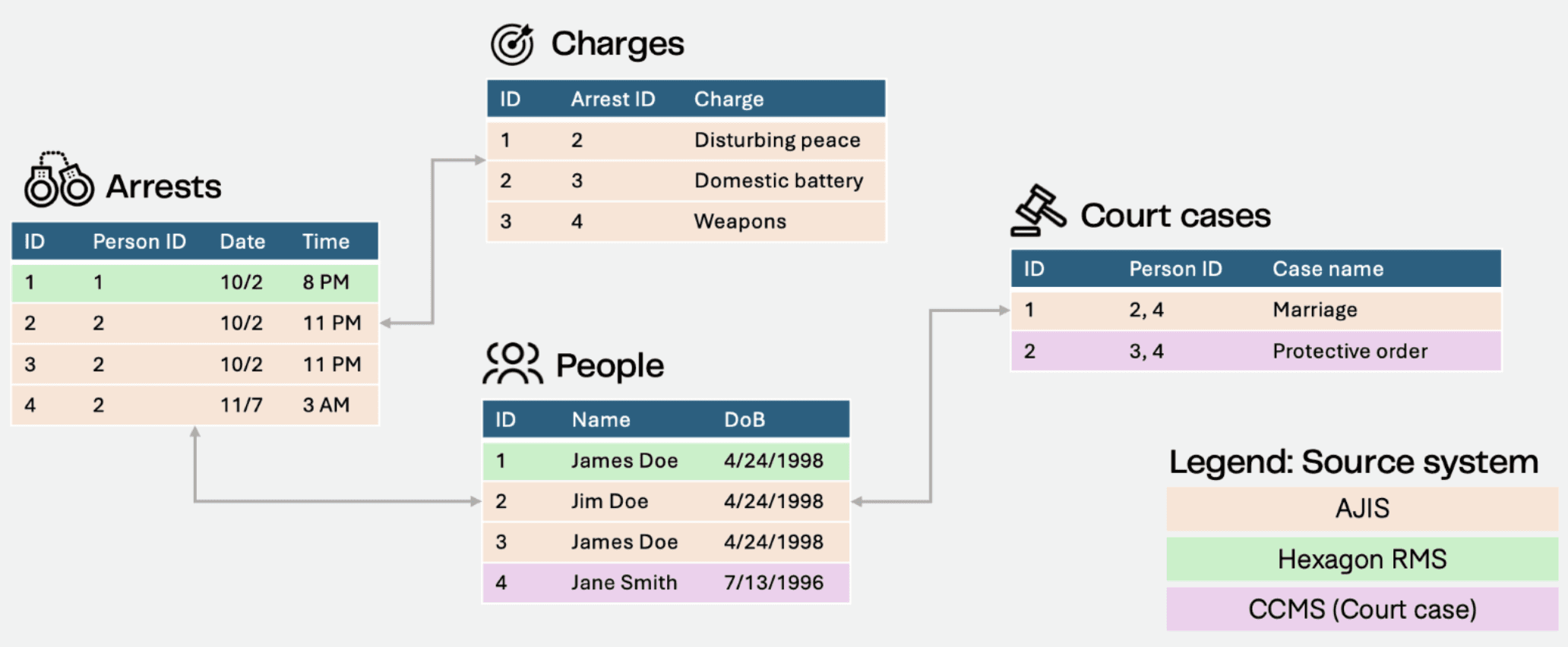
To solve this, Peregrine used a proprietary entity resolution solution, Peregrine Match, to automatically and securely merge similar records across systems.
For example, consider a case where James Doe entered the RMS as James Doe but entered AJIS as Jim Doe.
- Using machine learning, Peregrine's entity resolution methodology merges these records into a single "match.”
- Peregrine flags the match with an icon to indicate that it’s a merged record.
- Alexandria personnel can click into each match to review detailed information about the merging process, including a list of the original data sources involved.
Match provides users with a comprehensive view of an individual's interactions with the justice system, saving city personnel time and effort over sifting through numerous records that often lack context.
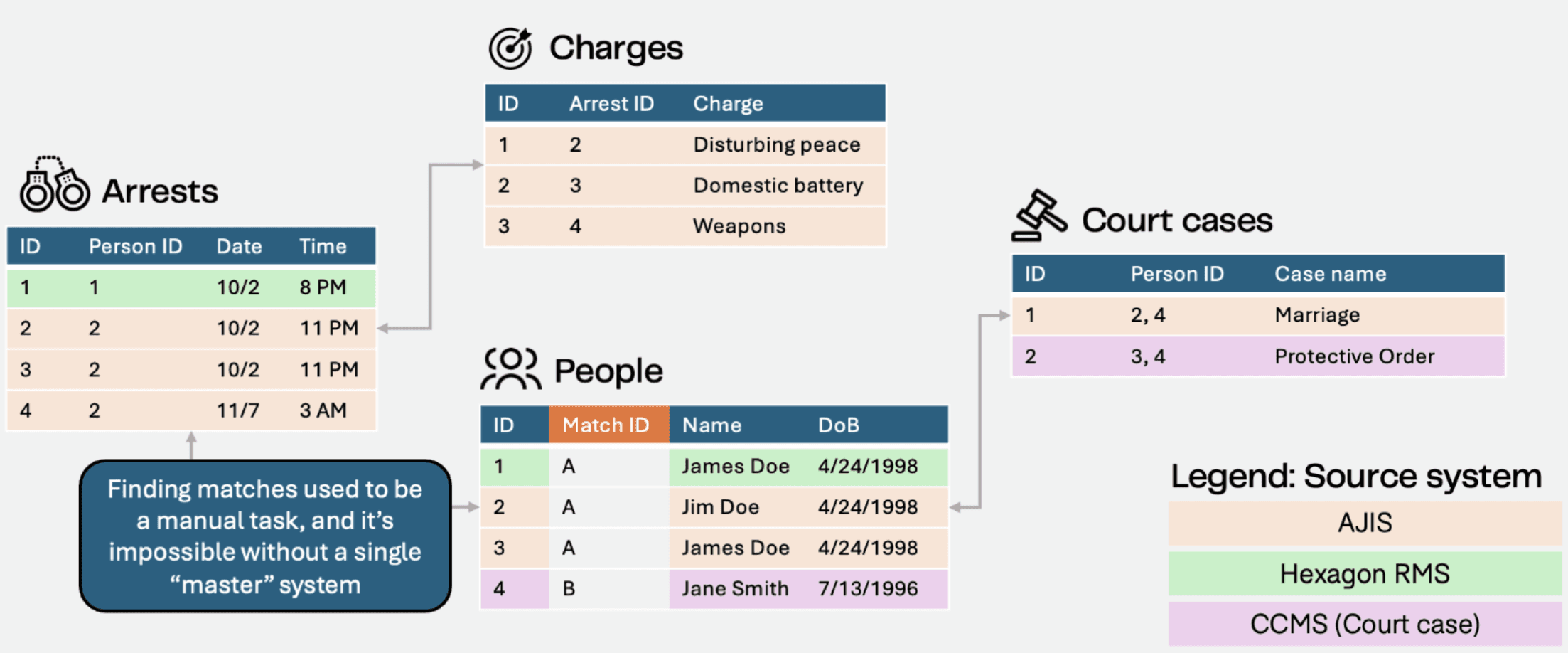
To ensure data security and accuracy, Alexandria personnel can also manually merge records if they have the correct permissions in Peregrine. This human-in-the-loop approach increases transparency, accountability, and trust in the data.
Peregrine Match allows Alexandria to reconcile inconsistent records across systems and build a complete, accurate view of each individual.
“This is game-changing,” Pledger said of Match.
🔑 KEY TAKEAWAY: Deduplication reconciles inconsistent records across systems, creating a single, accurate profile for each individual and restoring clarity across the justice system.
READ MORE → How the Cherokee Sheriff’s Office Integrated Corrections Data To Improve Jail Visibility And Safety
How unified data reveals patterns and relationships across cases
With data modeling and entity resolution in place, Alexandria has improved its ability to uncover trends that could impact public safety outcomes. For example, Alexandria can more easily connect cases, arrests, and documents such as marriage licenses and protective orders.
In the past, these records may have lived in different systems and been difficult to connect, but Peregrine brings them together to provide a clearer, more complete view of a person’s interactions with the justice system. This allows agencies to move from isolated records to a connected understanding of people, cases, and events.
🔎 HOW DOES CONNECTED DATA REVEAL PATTERNS ACROSS CASES?
When records from multiple systems are unified and deduplicated, agencies can link incidents, individuals, and documents to identify patterns that are not visible within any single system.
The example below illustrates the story of James (or Jim) Doe and Jane Smith, a married couple. Jim entered the system through multiple pathways and under different variations of his name. Peregrine merges those similar records, making Jim’s arrest and charge data clearer and easier to understand.
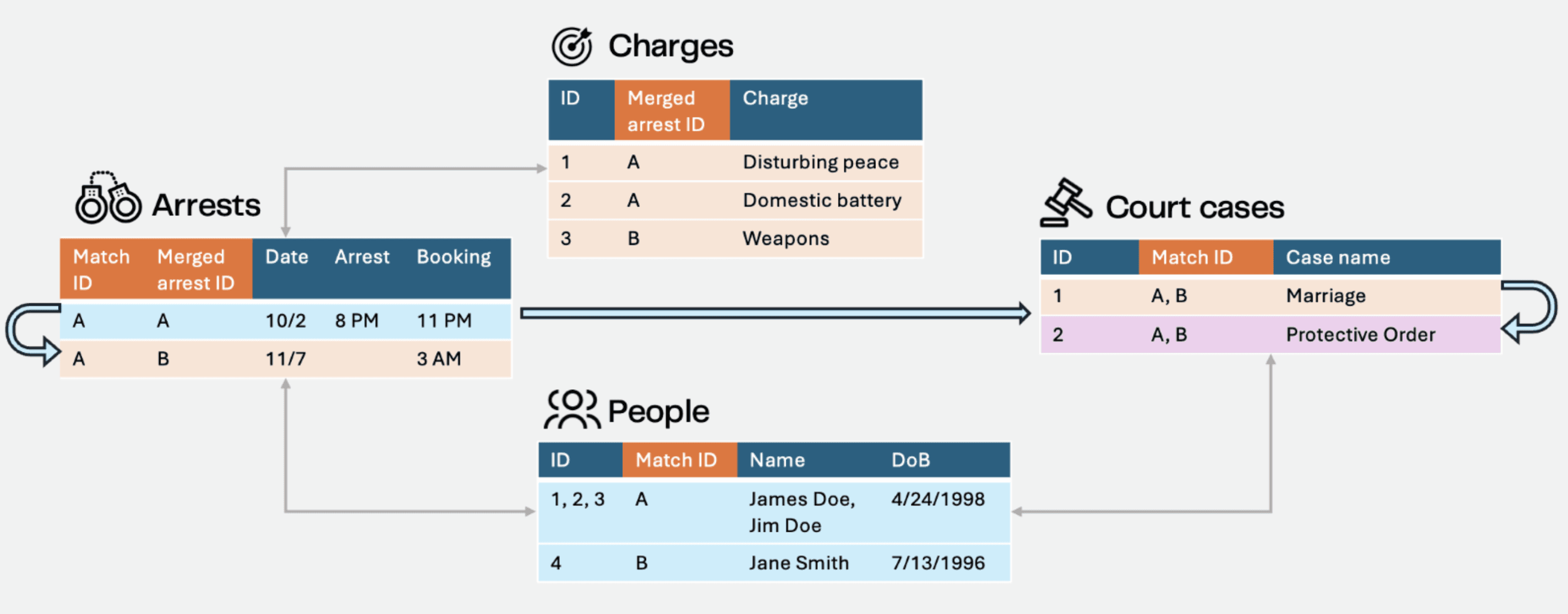
Peregrine draws connections among various incidents involving Jim, each sourced from a different information system:
- Jim’s arrest for domestic battery on Oct. 2 (source: RMS)
- Jane’s protective order following Jim’s domestic battery arrest (source: CCMS)
- Jim's arrest for a weapons charge on Nov. 7 (source: AJIS)
By connecting the above incidents, Peregrine reveals a pattern of domestic violence between Jim and Jane that may not have been visible in any single system. This integrated view provides a more complete understanding of the situation and helps inform critical follow-up actions, such as checking on Jane’s safety after Jim’s latest arrest. This type of insight is only possible when data across systems is unified and deduplicated.
🔑 KEY TAKEAWAY: By connecting data across systems, Peregrine enables agencies to uncover patterns that would otherwise remain hidden, helping inform faster, more effective public safety decisions.
How a unified view of data improves justice system coordination
Peregrine provides context around each data point, helping agencies understand not just what happened, but why, providing valuable context for public safety incidents. As a result, agencies have a shared understanding of what is happening across the justice system. Pledger emphasized the importance of drawing those connections to gain a deeper understanding.
READ MORE → 3 Ways Custody Professionals Are Solving Critical Problems With Better Access to Data
“We need to start by asking questions like, ‘What warrants are being issued? What crimes are being committed? Who is coming in and out of jail, and why? What resources do people need to prevent them from recidivating? How do we ensure courtroom processes are fair and unbiased?’ The answers to those questions are crucial to having a more effective and fair justice system,” Pledger said.
Pledger said she believes in the power of creating a true common operating picture across justice and public safety.
🔎 WHY IS A COMMON OPERATING PICTURE IMPORTANT IN JUSTICE SYSTEMS?
Without a shared view of data, agencies operate in silos, making it harder to coordinate actions, understand context, and make informed decisions.
“The goal must be nothing less than a continuous and robust understanding of what is happening, when, and where, from the beginning of the judicial process to the end,” she said.
Peregrine supports this common operating picture by allowing city personnel to work across all systems in a single interface, reducing the need for multiple logins and disconnected workflows. This enables users to access information faster, understand data in context, and make more informed decisions across the justice system, improving outcomes for both city staff and Alexandria residents.
🔑 KEY TAKEAWAY: A common operating picture allows agencies to move from isolated data to shared understanding, improving coordination, decision-making, and justice system outcomes.
How unified data supports long-term justice outcomes and recidivism analysis
With Peregrine, Alexandria now has a unified, continuously updated view of its justice system, enabling agencies to connect cases, identify patterns, and act on risks in real time.
Looking ahead, Alexandria is starting to use dashboards in Peregrine to track recidivism and offer insights into reoffending patterns by pulling in information from its JMS, RMS, and CMS. As adoption expands, departments can apply these insights to new use cases, such as identifying repeat offenders, evaluating intervention strategies, and improving resource allocation.
🧠 WHY IT MATTERS: Without unified data, agencies struggle to track long-term outcomes, making it difficult to measure effectiveness or reduce repeat offenses.
Contact our team to learn how Peregrine’s data integration solution can support your community in creating a more connected, informed, and effective government.
Peregrine is built on AWS GovCloud.


 Your Privacy Choices