KEY IDEAS:
- The Cherokee Sheriff’s Office (CSO) lacked visibility into corrections operations due to fragmented data across siloed systems.
- Disconnected state and local records made it difficult to identify individuals and uncover connections.
- Peregrine integrates, cleans, and deduplicates data across systems, creating unified profiles for each individual.
- With unified, searchable data, the CSO can quickly identify individuals, uncover relationships, and flag risks to improve jail and community safety.
💡 CHEROKEE SHERIFF’S OFFICE AT A GLANCE:
Location: Cherokee County, Georgia
Population: Approx. 293,513
Total personnel: Approx. 493
Sources: CSO, U.S. Census
“With the same person, there could be 23 different entries, and I could never get the full picture of the who, what, where, and when without going into 23 different cases and reading every report. Peregrine's ability to merge entities and provide a quick, holistic view is huge for us.”
Lindsay Harris, Intelligence Division Commander, Cherokee Sheriff's Office
Cherokee Sheriff's Office

CHEROKEE COUNTY, Ga. — Before investing in data integration technology, Cherokee County’s corrections personnel struggled to draw connections across siloed systems and lacked a holistic view of operations.
If a deputy wanted to look up an inmate’s interactions with the state corrections system, they had to search the Georgia Department of Corrections (GDC) website. There, they could find information such as mugshots, incarceration history, physical descriptors, and aliases — but all of it lived separately from the county’s jail data. The CSO didn’t have a way to view and analyze all relevant data at once to fully understand an inmate’s profile and history.
Peregrine addressed this by:
- Integrating data across the CSO’s siloed systems
- Ingesting state corrections data from the GDC
- Cleaning and deduplicating records
- Linking individuals and their known connections
- Providing actionable insights for corrections personnel
Together, these capabilities enable Cherokee County to improve visibility, streamline workflows, and make safer, more informed decisions.
🔎 WHAT IS DATA INTEGRATION?
Data integration brings together information from multiple systems into a single, unified view, allowing agencies to analyze and act on all relevant data at once.
How integrating state and county data improves jail visibility and safety
"The amount of time Peregrine saved me by connecting the individuals and providing a photo from an outside agency is invaluable." —Lindsay Harris, Intelligence Division Commander, Cherokee Sheriff's Office
With records fragmented across disconnected systems, Cherokee County corrections personnel lacked a complete, real-time view of inmates, visitors, and their connections. That lack of visibility made it difficult to identify risks and ensure jail safety.
To address these challenges, Cherokee County turned to data integration to unify information across systems. Working closely with the GDC, Peregrine ingested and integrated:
- State-level corrections data from the GDC
- The CSO’s records management system (RMS), jail management system (JMS), and jail visitation system
- Data from partner agencies, such as the Cartersville Police Department and MARTA Police Department
Peregrine brought those disparate sources into one interface. This allowed CSO personnel to securely access GDC data, in bulk, and search against all integrated sources in a single system — no more scrolling through mugshots on GDC’s website. This capability directly impacts day-to-day jail safety.
📖 REAL-WORLD IMPACT: Using Peregrine, the CSO was able to identify a Cherokee County Jail visitor who gave false contact information in a matter of minutes.
CSO Intelligence Division Commander Lindsay Harris explained how Peregrine helped her identify a visitor who provided false contact information when signing in.
- Harris only had two real pieces of information to work with: the visitor’s provided home address, which wasn’t associated with the visitor but was a valid address, and footage from the video visit.
- Harris searched the address in Peregrine, which revealed the individuals associated with that residence and those individuals’ known connections.
- The visitor was not directly associated with the address, but they were connected to someone who was. As a result, the search returned the visitor as a known connection, including their GDC mugshot.
"I was able to affirmatively identify the individual simply by glancing at a photo within a large list of possible associates in Peregrine," Harris said. "Without having a name, establishing this connection and matching it to a picture in a separate database would have been nearly impossible to accomplish."
By integrating state corrections data, Peregrine enabled Harris to identify the visitor in minutes — something that would have been nearly impossible before.
"The amount of time Peregrine saved me by connecting the individuals and providing a photo from an outside agency is invaluable,” Harris said.
With access to unified, searchable data, the CSO can quickly identify individuals and uncover connections that would otherwise remain hidden. But identifying individuals is only part of the challenge. The CSO also needed a complete view of each person across systems.
🔑 KEY TAKEAWAY: Without integrated data, corrections personnel struggle to identify individuals and their connections. By unifying state and local data, the CSO can quickly surface identities and relationships, improving jail safety and situational awareness.
How record deduplication improves inmate visibility and data accuracy
While data integration improves visibility across systems, duplicate records can still make it difficult to build a complete picture of an individual. Many law enforcement agencies struggle with dirty data: incomplete or inconsistent information that leads to duplicate records across systems. An agency may have multiple records related to a single individual, making it difficult to draw connections or identify patterns.
🔎 WHAT IS RECORD DEDUPLICATION?
Record deduplication identifies and merges duplicate records across systems to create a single, accurate profile for each individual. After ingesting an agency’s data sources, Peregrine cleans and unifies records to reduce noise and increase clarity.
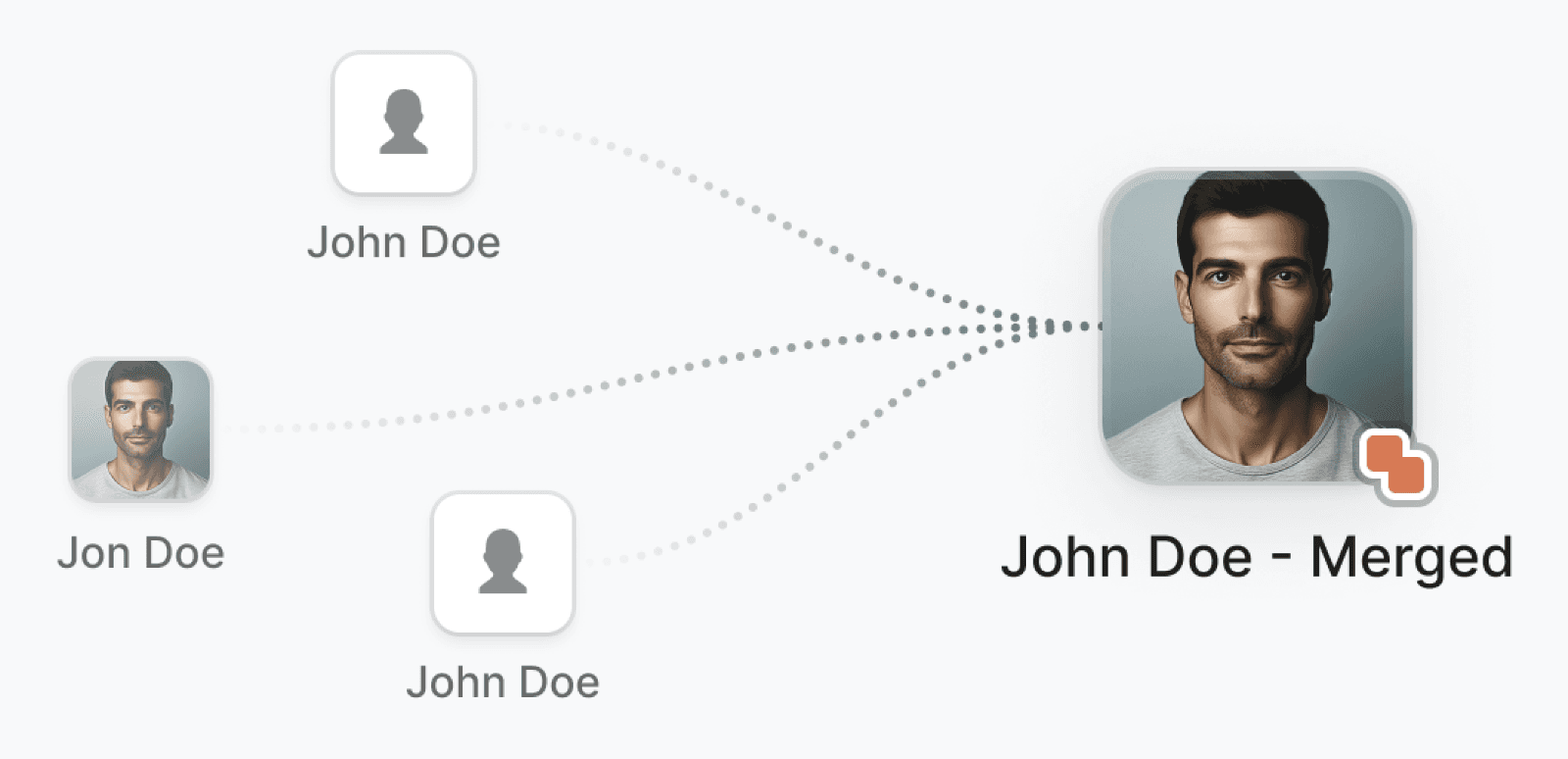
Let’s use the hypothetical John Doe as an example:
- CSO RMS: John Doe entered the CSO's RMS in 2021 when he was arrested for shoplifting.
- CSO JMS: John entered the CSO’s JMS when he spent the night in the Cherokee County Jail following his 2021 arrest.
- GDC offender database: In 2023, John was arrested again for shoplifting. This time, he was incarcerated in a state prison. He entered the GDC’s offender database as Jon Doe, using an alternative spelling of his first name.
That’s three different records across three systems — under two different names — for the same individual.
Peregrine solves this by creating a single, unified record for each individual using a proprietary algorithm called Match, which deduplicates records across all integrated data sources. Match links related records across systems, making connections between individuals easier to identify.
🔎 WHY DO DUPLICATE RECORDS MATTER IN CORRECTIONS?
Duplicate records can hide critical information about an individual’s history, making it harder to identify patterns, connections, or risks.
For the CSO, Match merges person records across all integrated GDC and CSO data systems. This allows CSO personnel to search against multiple data sources simultaneously and return clean, organized results, without having to piece together similar person records from various information systems.
In the case of John Doe, Peregrine Match would:
- Identify those duplicative entities
- Create one collective John Doe record compiling information from the CSO’s RMS, the CSO’s JMS, and the GDC’s offender database
- Flag his record as “merged” and provide the source data for transparency
This makes it faster and easier for CSO personnel to gain a full picture of John Doe.
READ MORE → Unifying Corrections: Operational Challenges and Modern-Day Solutions
Harris said Match has been particularly helpful for the agency’s legacy RMS, which was riddled with duplicate person records.
“With the same person, there could be 23 different entries, and I could never get the full picture of the who, what, where, and when without going into 23 different cases and reading every report,” Harris said. “Peregrine's ability to merge entities and provide a quick, holistic view is huge for us.”
Using Peregrine, corrections personnel can find the information they need faster, increasing situational awareness and enabling better decisions.
🔑 KEY TAKEAWAY: Duplicate records prevent agencies from seeing a complete picture of an individual. By merging records across systems, the CSO can quickly access accurate, unified profiles in Peregrine, improving visibility and decision-making.
How integrated jail data improves inmate housing and threat detection
With a unified view of individuals, CSO can apply these insights to day-to-day jail operations. With access to the right data from the right sources, the CSO can:
- Better leverage its jail data to identify visitors
- Make informed decisions about inmate housing
- Support investigations to keep county jails and neighborhoods safer
READ MORE → Cherokee Sheriff’s Office: Transforming Overdose Insights From Spreadsheet to Strategy
Using data to improve inmate housing decisions
Harris said she uses jail booking information in Peregrine to more accurately identify gang-affiliated inmates. She built out jail administration dashboards in Peregrine to illustrate where current gang-affiliated inmates are housed, improving situational awareness and informing housing decisions for jail personnel. This visibility directly improves how inmates are housed and monitored.
🧠 WHY IT MATTERS: Without visibility into inmate affiliations and relationships, housing decisions can unintentionally increase risk within a facility.
“I created charts showing gang affiliation by housing unit and security classification so jail staff could quickly make informed decisions. In one pane of glass, deputies can see that there is a Sureño, an Outlaw, and a Ghostface Gangster all in M Pod. Is this something we need to be concerned about?” Harris said. “They never had the ability to see that before.”
🔎 HOW DOES JAIL DATA IMPROVE INMATE HOUSING DECISIONS?
Integrated jail data allows agencies to identify factors like gang affiliation, prior incidents, and inmate connections, helping staff make safer and more informed housing decisions.
Using integrated data to identify potential threats
Beyond housing decisions, integrated data also helps the CSO identify external risks and potential threats. Before Peregrine, CSO users couldn’t search jail visitor data by phone number, email, or address, even though all visitors must provide that information to enter the jail. Now, users can seamlessly access jail visitation data alongside the agency’s other data sources.
Peregrine’s integrated search capabilities allow users to query across people, addresses, and connections in a single search. This makes it easier to identify gang-affiliated individuals and even houses. With one search, Harris could use Peregrine to find every inmate associated with the Ghostface Gangsters who had a visitor from a particular area.
In another example, Harris noticed that four different people visiting four different inmates all gave the same home address. She could also see that each inmate was associated with the same gang. This suggested the visitors’ residence could be a gang-affiliated location.
🔑 KEY TAKEAWAY: With integrated jail data, the CSO can move from reactive responses to proactive decision-making, improving housing assignments, identifying threats earlier, and increasing overall facility safety.
💡 HOW UNIFIED DATA IMPROVES JAIL SAFETY AND SITUATIONAL AWARENESS:
- Visitor identification → reduces risk from unidentified individuals
- Record deduplication → complete inmate visibility
- Housing dashboards → better risk management
- Visitor analysis → surfaces potential gang networks
How Peregrine enables safer, more informed jail operations
With Peregrine, CSO has a unified, real-time view of inmates, visitors, and their connections — enabling faster decisions, stronger situational awareness, and safer jail operations.
The CSO leverages Peregrine’s data integration technology to streamline its jail management workflows, from identifying visitors to building more complete inmate profiles using data from multiple sources and agencies. By unifying and linking data across systems, Peregrine enables CSO personnel to better flag problems, identify trends, and implement solutions in their correctional facility and beyond.
🔑 KEY TAKEAWAY: By unifying data across systems, the CSO moved from fragmented, manual workflows to real-time visibility, enabling faster decisions, improved situational awareness, and safer jail operations.
Contact our team to learn more about how data integration can improve visibility, decision-making, and safety in your agency.
🔎 WHAT DOES PEREGRINE DO FOR CORRECTIONS AGENCIES?
Peregrine integrates data across systems, deduplicates records, and links individuals, addresses, and connections into a unified view, enabling faster searches, better decisions, and safer operations.


 Your Privacy Choices