
How Peregrine eliminates manual NIBRS reporting
Author
Staff
Peregrine
Published
December 18, 2023
Last Updated
September 22, 2026
Author
Staff
Peregrine
Published
December 18, 2023
Last Updated
September 22, 2026
Share


KEY IDEAS:
- To comply with federal NIBRS reporting requirements, law enforcement agencies must map local, state, and legacy SRS offense codes to the correct NIBRS classifications.
- Differences across these coding systems can lead to inaccurate or incomplete crime reporting.
- Peregrine integrates agency data, automatically maps offense codes, and reduces the manual work required for NIBRS reporting.
- By automating NIBRS reporting, law enforcement agencies can improve reporting consistency, better understand crime trends, and spend more time on high-impact analysis.
In January 2021, the Department of Justice transitioned from the Summary Reporting System (SRS) to the National Incident-Based Reporting System (NIBRS) in the FBI's Uniform Crime Reporting (UCR) Program. Now, NIBRS reporting is the national standard for law enforcement crime data.
Reporting crime statistics, whether on a national, state, or local level, is vital for informing crime prevention strategies and building stakeholder support with communities and elected officials to improve public safety.
However, collating and sharing crime statistics remains a time-consuming, manual process. Many law enforcement agencies struggle to synthesize data for timely, meaningful internal reporting, and federal crime reporting is even more complex because it requires additional data standardization. To meet these requirements, agencies need reporting workflows that reduce manual work, improve consistency, and make crime data easier to analyze.
🧠 KEY CONCEPT: NIBRS REPORTING
The National Incident-Based Reporting System, or NIBRS, is the FBI’s national standard for collecting detailed crime data from law enforcement agencies. Unlike the older Summary Reporting System, NIBRS captures more incident-level details, which can make reporting more complete but also more complex.
Valid concerns about inaccurate, incomplete, or sensitive data can slow both proactive and reactive reporting, whether agencies are preparing NIBRS reports or another data set.
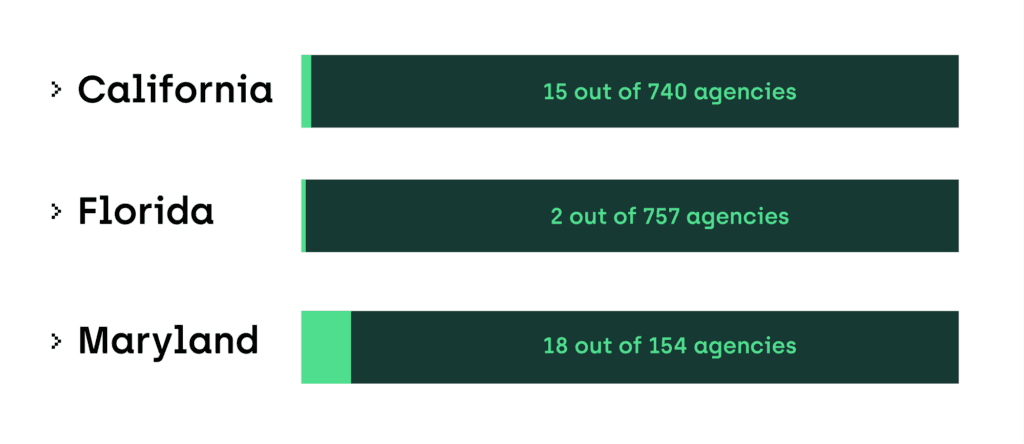
The logistics of collating fragmented information simply make timely reporting too hard. Case in point: In 2021, according to the FBI, the overall crime statistics for California, Florida, and Maryland were based on NIBRS reporting from only a fraction of law enforcement agencies in each state for that year.
READ MORE → How Menifee PD Uses Unified Data for Faster Crime Analysis
The challenge lies in how police departments categorize criminal offenses. Most codes that correspond to a given crime are state or local codes that align with a state or municipality’s criminal statutes.
Today, agencies use SRS codes — from the old UCR reporting framework — as well as state and local codes. Because of the transition to NIBRS, police departments must use the proper NIBRS code when reporting crime statistics in their jurisdiction.
📊 KEY FACT: There are nearly 18,000 police departments across the U.S., and they all use different combinations of local, state, and federal codes.
This poses a few challenges:
As a result, SRS, state, and local codes for a given crime must be mapped to the corresponding NIBRS code when a department shares crime statistics with the federal government. Each department might have different codes for different offenses, so there is no one-size-fits-all solution, making the mapping process manual and onerous.
CASE STUDY → How the Richmond Police Department Improves Police Reporting With Real-Time, Unified Data
Let’s use a hypothetical example with notional codes for a criminal offense that mirrors the manual mapping police departments do today. The SRS offense code used by a given police department for negligent manslaughter with a vehicle is 0824. The state code is 0722.
So, when there is an instance of negligent manslaughter with a vehicle, a police officer might denote the crime using one of the codes. It’s even possible that two officers in the same department might use different codes to denote the same crime.
When it’s time to report crime statistics to the FBI, SRS and state-level codes need to be mapped to the NIBRS code for the same offense, 08A.
There are literally thousands of different crimes, each of which could have multiple codes across various reporting regimes. Manually translating every single type and instance of every crime over the course of a year into the proper NIBRS code is complex and time-consuming.
The example used above is a simple one: there’s a 1:1 relationship between an SRS code and a NIBRS code. But that’s not always the case. Crimes across different reporting regimes don’t always have a 1:1 correlation, which can lead to multiple officers classifying the same crime differently due to the code they use, resulting in errors in federal crime data.
🔑 KEY TAKEAWAY: Crime codes are not consistent across local, state, and federal reporting. To submit accurate NIBRS reports, agencies must map those different codes to the correct federal offense categories, a time-consuming process that can result in inaccurate or incomplete data.
Police department personnel want to spend their time serving and protecting communities, not struggling with manually collating crime statistics.
So, Peregrine delivered a better way forward: an automated tool to map disparate crime codes to the NIBRS codes, quickly and accurately.
Today, Peregrine customers can use configurable, automated criminal code mapping in our platform. The mapping tool is unique to their agency, our dynamic data model eliminates the need for an army of software engineers to get involved in gathering requirements for each change or update to data assets in Peregrine.
For example, suppose that an agency introduces a new crime code that needs to be mapped to a specific NIBRS code for all future police reports in which it is used; Peregrine can quickly adapt to that new information within minutes, with no cumbersome update or change order needed.
💡 HOW IT WORKS: Peregrine’s dynamic data model helps agencies map local, state, and legacy SRS codes to the correct NIBRS codes, reducing manual work and simplifying federal crime reporting.
- Think of a data model as a digital blueprint of the world, containing all the objects your staff analyzes and connects when they run a search, produce a report, or respond to a call for service.
- Each object is a collection of attributes, For instance, a vehicle’s attributes are its make, model, and year.
- Our data model knows how objects relate to one another in the real world and automatically creates links between objects.
LEARN MORE → How Peregrine Integrates Data and Delivers Value in 90 Days
Our customers are free from manually mapping state, local, and SRS codes to NIBRS codes. Changes that are simple in Peregrine would take dozens of hours in an RMS or CAD system because of the custom coding required.
🔑 KEY TAKEAWAY: Automating NIBRS reporting helps agencies reduce manual work, improve reporting consistency, and reallocate staff time toward analysis, investigations, and public safety priorities.
Peregrine’s process is easy, automated, and unique to every department we work with. Rather than spending dozens of hours manually wrangling NIBRS reporting or wrestling with unwieldy software, our customers can reallocate that time toward preventing and reducing crime, producing sophisticated crime analyses, or coordinating with neighboring departments.
For too long, cutting-edge technologies that allow organizations to get the most from their data have been reserved for the largest federal agencies and Fortune 500 companies.
Those days are over. Peregrine is helping agencies move beyond manual NIBRS reporting so they can spend less time wrangling data and more time turning it into actionable public safety insights. Find out what we can do for you today.
The National Incident-Based Reporting System (NIBRS) is the FBI’s national standard for collecting detailed crime data from law enforcement agencies. NIBRS replaced the Summary Reporting System (SRS) and requires agencies to report more complete, incident-level information.
For media requests,
contact media@peregrine.io
 Your Privacy Choices