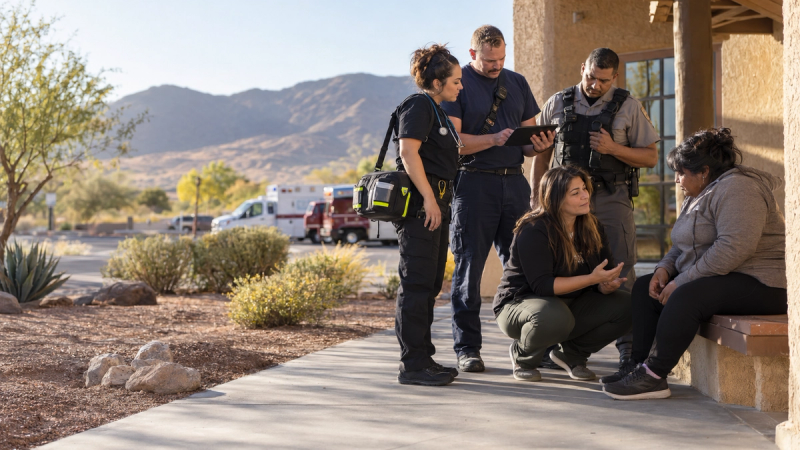
Every city that considers building an alternative crisis response program eventually runs into the same wall: the idea is easy to agree on, but proving it's working is not. Response times sit in one CAD system, dispatch criteria live in someone's institutional memory, and the question elected officials actually ask, "are we sending the right resource to the right call?", turns out to be much harder to answer than it sounds. That gap between believing a program works and being able to show it is what most of these programs quietly struggle with, whether they call it co-response, alternative response, or something else entirely.
That gap was the real subject of a webinar we hosted recapping five years of Albuquerque Community Safety (ACS), the city's civilian-staffed "third branch" of public safety. I moderated, drawing on my time as Albuquerque's Chief of Police and as former president of Major City Chiefs.
Our panelists came from across Albuquerque’s public safety services:
- Executive Director Raul Bujanda, Public Safety, City of Albuquerque
- Director Jodie Esquibel, Albuquerque Community Safety (ACS)
- Fire Chief Emily Jaramillo, Albuquerque Fire Rescue (AFR)
- Chief Cecily Barker, Albuquerque Police Department (APD)
Here's what stuck with me:
Co-response needs to get the right responder to the right person
Director Esquibel put it simply: ACS responds to calls that are explicitly non-medical, non-fire, and non-criminal, the calls that historically defaulted to police or fire because there was nowhere else to send them. Today that's close to 4,000 calls a month.
That's a meaningfully different ask than most cities are used to making of a new department. As Esquibel explained it:
"This is the only thing I knew. I knew that we needed some sort of structure, operations, protocols, standards... And now I feel like we can stand next to the other chiefs here in public safety."
A program like this is ultimately judged on whether it can show, call by call, that the right responder showed up. Both APD and AFR needed to see the data behind ACS hold up, consistently, before either agency was willing to hand off a call.
Trust, built on numbers
Chief Barker was candid that the early resistance inside APD centered on whether unarmed civilian responders could be trusted with calls that might turn dangerous:
"There was a lot of concern across the department... whether that be from beat officers all the way through the ranks, that we were going to have professional staff or civilians responding to calls and the concern that they would be injured."
Director Esquibel described the same pattern from the dispatch side, before ACS had built out its own triage function:
"I think there was trust. I think there was uncertainty. I think that there were unclear call criteria... It's gonna take a lot of time for us to redefine that public safety model."
What closed that gap was a number: of roughly 4,000 monthly ACS calls, only about 1.2% get kicked back to APD for safety reasons. Albuquerque got officers and firefighters to trust the program once the record was long enough to check.
Program spotlight: Golden Opportunity
Albuquerque Fire Rescue's paramedics carry Suboxone in the field as part of a partnership with ACS called Golden Opportunity, built over the past year with providers who reserve treatment beds for patients on the spot. Patients who are stabilized get a bracelet signaling they can call ACS for a ride straight into treatment. Chief Jaramillo credits the program with reducing repeat calls to the same unhoused, substance-use population AFR was previously seeing again and again with no path forward.
From "call APD to secure the scene" to a two-second decision
Chief Jaramillo walked through how differently a "person down" call gets handled today versus before ACS existed. A person sleeping on a bench used to trigger an automatic APD dispatch to secure the scene, then a fire unit to assess someone who often had no medical complaint at all. Today, ACS's own proactive patrols intercept many of those calls before 911 is ever dialed, and the data trail is what makes the case:
"It's a little bit harder to show how many calls AFR isn't taking because ACS responders stopped to check on that person that was sleeping before the 911 call came in."
Director Esquibel’s favorite example of that shift was a dispatch decision. ACS's embedded "triage specialist," an actual ACS field responder cross-trained on dispatch protocols, sits inside the emergency communication center so a dispatcher who's unsure whether a call is ACS-appropriate can ask, in real time, instead of guessing:
"If there's a call that is in question... they can consult with the triage specialist, and then they can make a decision together."
Chief Barker also pointed to the enhanced crisis intervention team, which pairs a clinician with responding officers, as proof that this same coordination now runs through APD's own units, not just ACS's.
Co-response as a standing structure
The clearest theme of the hour: cities that treat this as a temporary pilot to placate advocates are setting themselves up to relitigate the whole program in year three. ACS has used its own data, transport rates up 76% year to date, to justify splitting citywide coverage into geographic quadrants and to defend its budget to elected officials worried that funding ACS meant defunding police or fire. Director Bujanda has heard that objection directly:
"At the end of the day, you have to explain it for what it is. You’re not taking away funding. You’re creating a new system that provides the resources you’ve needed all along."
I've watched this play out for years from inside a police department. When officers see, concretely, which calls are no longer landing on their plate, they buy in. Chief Barker's read on what actually built that trust matched mine exactly:
"I do think with the current director, the communication that we have is a lot better than just historically, and I think that that's the biggest key point."
How co-response models get built
Everything the panel discussed comes down to the same operational problem underneath most public safety modernization efforts: agencies running separate systems that were never built to inform each other in real time. Cities pursuing a similar model typically need to work through three things at once:
- Shared dispatch criteria. APD, AFR, and ACS didn't align by accident. It took an embedded triage specialist and years of joint protocol work to get a dispatcher's judgment call down to a shared, documented standard.
- Data that survives a budget hearing. Call volume alone doesn't convince a city council. Transport rates, response times by call type, and calls diverted before 911 was even dialed are what turn a request for trust into a request backed by evidence.
- A path that doesn't dead-end at the ER. ACS's value depends on having real destinations, sobering centers, shelters, treatment beds, to transport to. Without that network, the model relocates the same problem rather than solving it.
How Peregrine supports co-response models
Those challenges are are the same problems Peregrine was built to solve for agencies running alternative crisis response programs. Cities use Peregrine for co-response support across three main areas of this work:
- Call diversion reporting. Peregrine connects CAD, dispatch, and records data across police, fire, and co-response units so a department can show call volume, transport rates, and diversion outcomes without stitching together spreadsheets by hand, whether that report is headed to a peer review team, a city council, or a grant application.
- Dispatch and triage coordination. Peregrine brings shared call criteria and real-time data into one operating picture, so a dispatcher or triage specialist can make a call-routing decision with the same information every agency involved is looking at.
- Program accountability and growth planning. Peregrine surfaces the data behind decisions like adding a second unit, splitting coverage into quadrants, or expanding into a new call type, so agencies can make that case with evidence rather than intuition.
More than 400 public agencies across law enforcement, fire-rescue, and emergency management already trust Peregrine with their most sensitive operational data. To see the full model behind what Albuquerque built, and how other cities are adapting it, download our complete guide to co-response programs, or watch the full webinar recording for the unedited conversation.
About the author
Chief Harold Medina (Ret.) is a Public Safety Innovation Lead at Peregrine. A native of Taos, New Mexico, he devoted 30 years to law enforcement, serving most of his career with the Albuquerque Police Department where he rose through the ranks to become the first Hispanic Chief in 15 years. After retiring as a Commander in 2014, Medina was hired as the chief of the Laguna Pueblo Police Department, an opportunity that provided him with a broader view of community policing and working with different cultures. Medina returned to Albuquerque in 2017 to serve as Deputy Chief of the Field Services Bureau. After three years, he took on the role as interim Chief of Police, and he was formally appointed as Chief of Police in March 2021. Chief Medina has earned a reputation for aggressive crime fighting, while leading the culture change to embrace Constitutional policing. Chief Medina continues to build partnerships with other law enforcement agencies, as well as community organizations and disenfranchised populations that have historically viewed police with distrust. He also served as President of Major City Chiefs his last year.
Frequently asked questions
Does a co-response program need to be its own department, or can it sit inside police or fire?
Albuquerque's leadership was direct on this: independence mattered. Director Esquibel estimated it accounted for roughly 90% of ACS's success, since folding it under APD or AFR tends to blur funding, mission, and scope in ways that slow the program down.
How do cities get police and fire departments to actually hand off calls?
Trust built on a track record. Albuquerque's data shows only about 1.2% of ACS calls get kicked back to police for safety reasons, and that number, tracked and shared consistently, is what shifted officer buy-in over time.
What happens to calls that don't fit clean categories?
Albuquerque built a "Priority One" designation for cases like active suicidal ideation, developed jointly with its emergency communication center, so responders on scene have a clear, shared standard for when a call needs an immediate warm handoff to ACS.
How does Peregrine help agencies running or building a co-response program?
Peregrine connects the systems a co-response program and its partner agencies already run, including CAD, dispatch, and records management, into one shared view. Instead of each agency tracking its own numbers separately, departments get reporting on call diversion, response outcomes, and transport rates built from all of it at once, cutting the reporting work that used to take days down to minutes.
What data sources can Peregrine integrate across police, fire, and co-response units?
Peregrine works with the systems most agencies already have in place: CAD, RMS, dispatch platforms, GIS, and staffing systems, among others. Peregrine's forward-deployed engineers build the connections to whatever mix of systems a city runs across its police, fire, and co-response departments, rather than requiring every agency to adopt the same vendor stack.
Does Peregrine replace our existing CAD or dispatch systems?
No. Peregrine sits on top of the systems agencies already own rather than replacing any of them. It's the layer that connects police, fire, and co-response data so the numbers each agency already collects can finally answer a shared question together.
How long does it take to deploy Peregrine for a co-response program?
Peregrine can be deployed in as little as 90 days. Forward-deployed engineers handle the integration work directly and configure the platform around each agency's own systems, call criteria, and reporting needs, rather than handing over a generic dashboard.