Operational AI requires a foundation
Author
Ben Rudolph
Co-Founder, Chief Technology Officer
Peregrine
Published
March 30, 2026
Author
Ben Rudolph
Co-Founder, Chief Technology Officer
Peregrine
Published
March 30, 2026


Most enterprise work happens at the front lines, where individual people interact with enterprise systems of record in nonlinear patterns. A nurse checks a patient’s electronic health record, interview notes, lab results, and family history, then synthesizes all of it into a recommendation that’s entered into a chart. An airline operator monitors weather data, flight telemetry, and maintenance logs to identify and mitigate the risk of a delayed flight that might cost a carrier millions of dollars. A detective digs through years of case files, evidence logs, and old records, trying to find the next lead.
The above scenarios share three common threads:
Data harmonization. Each requires synthesizing information from fundamentally disconnected data sources: structured and unstructured, collected via different modalities, updating at different cadences, and operating at varying levels of trust and accuracy.
Operational context. Each occurs at the edge of the enterprise, where individuals drive the workflows that matter. They’re time-constrained and highly specialized. Generic interfaces lack the domain context to produce accurate and actionable outputs. Putting them in front of operators fails to build trust, drive adoption, or ultimately create impact.
Security and governance at scale. Businesses operate within layered security architectures and governance frameworks they've established across multiple systems: databases with their own access controls, use cases with their own compliance obligations, policies that vary by role and department. In complex enterprises, there's no unified layer to govern AI behavior across all of it. Without that layer, AI becomes a liability: either locked down to the point of uselessness, or deployed in ways that create unacceptable risk.
To make AI effective, you need all three: a foundation that translates your complex data environment into a form that humans and AI can work with together, a deep understanding of the processes that keep your organization running, and a unified security and governance layer.
This is where most AI deployments fall short. Standalone AI tools can summarize a document or answer a question about uploaded files. But they can't navigate your full data environment safely, resolve the same entity across systems, or understand what your data means in the context of how your organization operates. The solution isn’t more compute or bigger models. It's a foundation in data, your ways of working, and trust.
Peregrine has spent years building a platform rooted in the most challenging data environments imaginable. Underpinning every AI enhancement in Peregrine is an unwavering commitment to responsibility. In the sectors we serve, including law enforcement and public safety, reliability is table-stakes. The principles that govern how we build AI aren't unique to high-stakes environments. They're what any enterprise should demand from AI that touches important decisions.
Three principles govern how we build AI at Peregrine.
1. Responsible by design. Responsibility is embedded across the system lifecycle.
2. Verifiable. AI must be controlled, explainable, and rigorously sourced.
3. Human-centered deployment. AI complements human judgment. It does not replace it.
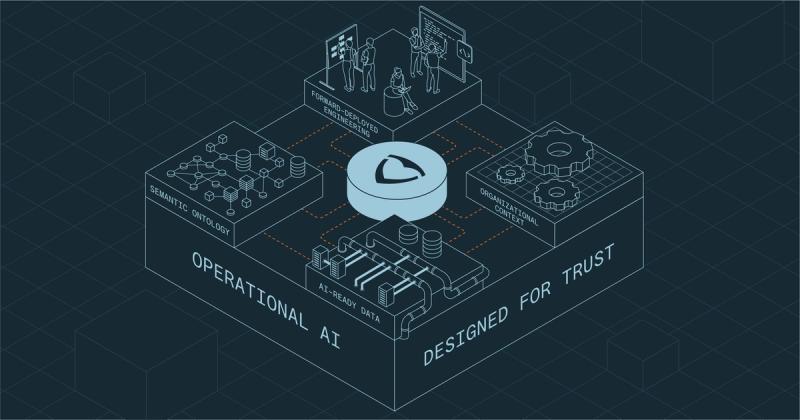
In order to prepare your environment for AI, enterprises must start by building a structured digital model — or semantic ontology — populated by curated enterprise datasets from your systems of record. This model acts as the essential map between raw data and actual business utility, enabling AI agents to learn and act within your environment.
The challenge in this step is quickly and effectively integrating and modeling your domain-specific enterprise data into a format that AI agents can effectively consume and activate. We’ve engineered Peregrine to natively handle structured data (e.g., databases), unstructured data (e.g., documents), and rich media, enabling seamless ingestion across a wide array of formats. Peregrine’s semantic ontology fuses these distinct modalities into a single, intelligible layer to define exactly what is meaningful to you.
Let’s return to the airline operator example. Peregrine translates raw data into a context-aware operational intelligence layer. The semantic ontology gives AI real-world meaning: weather delays at hub airports cause exponentially more disruption than delays at spoke cities; a broken lavatory can wait, while an engine issue grounds the aircraft. Crew regulations, maintenance windows, and flight schedules form a dense web of constraints that determine whether a minor issue stays small or becomes a $2M problem. By fusing structured and unstructured data, from maintenance logs to weather reports, Peregrine helps you understands operational impact, not just isolated data points.
Once the data is modeled, we use our platform to build tailored, persona-specific workflows that connect enterprise data and AI directly to the people who make decisions and take action. Peregrine gives your team the tools to define business logic and operational context directly in the platform, and our deployed engineering teams work alongside you to accelerate it. Whether it’s your lexicon, where “graves” refers to graveyard shifts rather than cemeteries, or your operational rhythm, where a weekly briefing needs to arrive Sunday night instead of Monday morning, we empower you to encode your institutional knowledge directly into your Peregrine experience. The result is an AI system built around how you operate.
This approach accelerates time to value, drives adoption, and turns AI outcomes into operational impact.
Peregrine sits as a unified layer above fragmented data sources. Define access controls, policy constraints, and governance rules once, and Peregrine enforces them universally across the platform. Whether a user is querying directly or an AI agent is acting on their behalf, every request respects what that identity is authorized to see and do throughout the platform.
This creates an identity-aware environment where security becomes consistent, transparent, and auditable. Organizations can move from fragmented, hard-to-reason-about controls to a centralized model of enforcement. The result is a foundation that enables organizations to deploy AI in regulated environments with confidence.
AI that works in the real world requires more than a model. It requires AI-ready data, operational context encoded into every workflow, a unified layer where security and governance are enforced across your entire data environment, and principles that ensure you can trust what it produces.
That's what we've built. And we're just getting started.
For media requests,
contact media@peregrine.io
 Your Privacy Choices