KEY IDEAS:
- Before Peregrine, the Coral Gables Police Department CompStat process required analysts to manually comb through several disparate information systems one by one to pull data for crime trend analysis.
- They then presented the results of their analyses using static slideshows that often contained outdated data.
- Now, Peregrine integrates Coral Gables PD’s data sources on one unified platform.
- Peregrine enables instant analysis and automates interactive data visualizations that update in real time.
- As a result, analysts save hours preparing CompStat briefings, and command staff are empowered to ask deeper questions of their data during CompStat meetings.
💡 CORAL GABLES PD AT A GLANCE:
- Location: Coral Gables, Florida
- City population: 50,379
- Agency sworn count: 210 officers
Sources: City of Coral Gables, U.S. Census
CORAL GABLES, Fla. — Today, the Coral Gables Police Department (CGPD) powers its CompStat program using Peregrine’s real-time data integration platform, which unifies:
- Live and historical crime data
- Calls for service
- Investigative intelligence
Chief of Police Ed Hudak said the agency went through several iterations of CompStat before landing on the current model. Previous versions of the program were static, rigid, and time-consuming.
“We all came to agree that one size doesn’t fit all,” Hudak said.
Peregrine enabled CGPD to create its current CompStat program: a dynamic, configurable, and collaborative model that goes beyond simple data visualizations. Peregrine-powered CompStat enables stakeholders to ask deeper questions of their data — and get better answers.
“Now, with CompStat, I’m able to answer the ‘why’s or the ‘what if’s with Peregrine, to show you, how many crimes happened in this one district? Now, let’s dive into the more granular stuff and look at the actual reports,” said intelligence analyst supervisor Julian Pozo. “It’s all on one pane of glass, which is really what I and the chief and this whole department need.”
💡 WHAT IS COMPSTAT?
CompStat is a data-driven policing strategy used by law enforcement agencies to analyze crime trends, inform resource allocation, and guide operational decision-making. Modern CompStat programs increasingly rely on real-time data integration, interactive dashboards, and cross-agency intelligence sharing.
How real-time data integration transformed CompStat for Coral Gables PD
“Peregrine allows you to be more granular, more in-depth, which saves me a lot of time.” —Julian Pozo, Intelligence Analyst Supervisor, Coral Gables Police Department
| CGPD CompStat before Peregrine | CGPD CompStat after Peregrine |
|---|---|
| Fragmented data: The agency’s crime and operational data was stored across multiple siloed systems that didn’t talk to each other. | Unified data: Peregrine integrates, cleans, and harmonizes data from CGPD’s siloed systems, allowing analysts to seamlessly cross-reference information from different sources. |
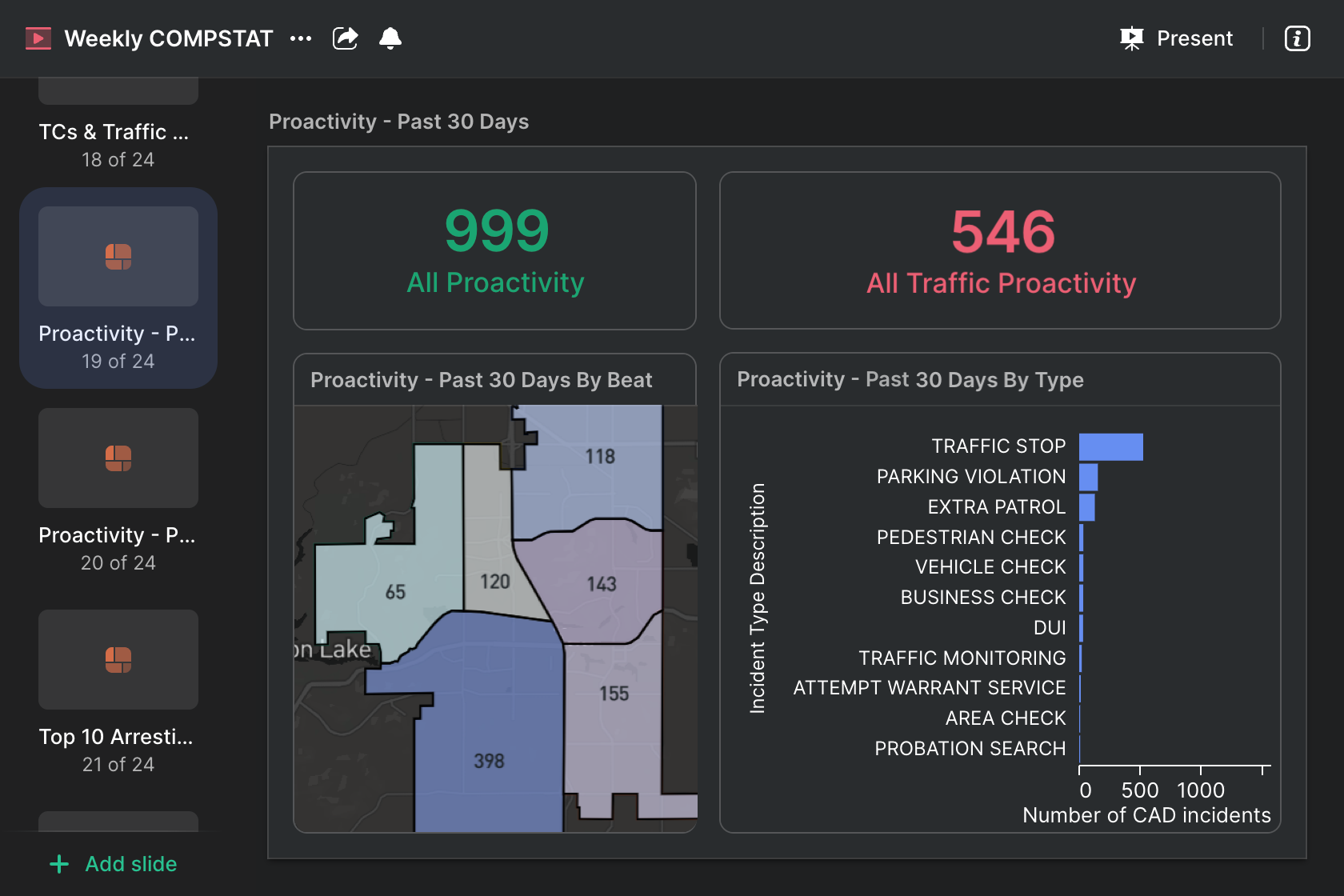
| Time-consuming preparation: Analysts spent hours manually pulling information from CGPD’s many disparate databases and compiling briefing materials for leadership. | Instant analysis: Peregrine automates data analysis and visualization through interactive, configurable dashboards that update in real time as new data flows in. |
| Point-in-time analyses: CGPD analysts prepared trend analyses every two weeks for CompStat meetings. The results reflected the agency’s data as of a static point in time, meaning the analyses were sometimes outdated by the time the CompStat meeting took place. | Real-time updates: Analysts no longer have to drop other tasks to conduct trend analyses every two weeks; with Peregrine, the analyses happen in real time on an ongoing basis. |
| Limited context: Because different types of data were housed in different systems that didn’t play well together, analysts were limited in their ability to cross-reference incidents, locations, and suspects. | Robust situational awareness: By integrating CGPD’s data sources, Peregrine makes it easy to cross-reference information from disparate systems, giving CompStat stakeholders a complete, contextualized understanding of crime in Coral Gables. |
| Static presentations: CGPD’s CompStat program relied on static slideshow presentations, meaning the information was often outdated or incomplete. | Dynamic presentations: Peregrine allows CompStat stakeholders to click on any component of a chart, graph, or map to view the underlying data and deepen their understanding of trends, patterns, and anomalies. |
The above image contains notional data.
How police departments use data integration to streamline CompStat
“It’s a living, breathing thing for analysts. We always look at the numbers. We always look at not just the numbers, but what that number means, what it is, how it’s going to impact.” —Julian Pozo, Intelligence Analyst Supervisor, Coral Gables Police Department
Effective CompStat relies on timely, accurate data. However, most CompStat meetings revolve around static slide decks that use days-old data and illustrate only high-level views of critical issues.
“The data for me is very essential, and I need it to be real time,” Pozo said. “I need to know what’s happening before the chief asks me, ‘hey, what’s going on with this?’ I should already know. I should have an answer for him right then and there.”
And while a static slide might tell you the “what” about a crime trend, it doesn’t help you get at the “why.”
By integrating data from disparate sources on one collective platform that automates analysis, updates in real time, and allows you to ask granular questions of the data being used, Peregrine takes CompStat to the next level. Here’s how it works.
CompStat 2.0: Leaving spreadsheets behind
Centralizing and cleaning police data for CompStat analysis
- Peregrine ingests, integrates, and harmonizes both structured and unstructured data from various sources, including publicly available sources, and agencies’ internal information systems.
- Peregrine also integrates data from retired information systems, marrying agencies’ live data sources with historical data from legacy systems to reduce context switching.
- Peregrine Match deduplicates redundant person records across all integrated sources, creating one clean, collective record for each individual.
💡 WHAT TYPES OF DATA DOES PEREGRINE INTEGRATE?
Peregrine can integrate data of any type — including structured, semi-structured, and unstructured data — from virtually any source, at any scale. Commonly integrated data sources for law enforcement agencies include:
- Records management system (RMS)
- Computer-aided dispatch (CAD)
- Jail management system (JMS)
- Digital evidence
- Body-worn camera (BWC)
- Automated license plate recognition (ALPR)
Integrating shared data from regional partner agencies
- When partner agencies share their data in Peregrine, they can seamlessly access and analyze all shared data in one unified view.
- In addition to Peregrine’s built-in governance and compliance features, agency administrators can determine data usage limitations and role- and attribute-based access controls to ensure all shared data stays secure and is only accessed by authorized users.
- Agencies can easily incorporate partners’ shared information in Peregrine when analyzing crime trends and creating data visualizations for CompStat.
💡 WHY IS INTERAGENCY COLLABORATION VALUABLE FOR COMPSTAT IN CORAL GABLES?
- In Miami-Dade County — which includes 34 incorporated municipalities — crime trends often cross jurisdictional lines.
- For Coral Gables PD, effective crime analysis must take neighboring jurisdictions’ data into account.
- Because many of Coral Gables’ neighbors also use Peregrine, CGPD’s CompStat process can easily consider information from the five agencies touching the agency’s borders.
- “We’ve noticed even more successes using this collaborative effort because now we’re able to touch the other jurisdictions, which we never were before,” Chief Ed Hudak said of his agency’s new Peregrine-powered CompStat process.
Automating real-time dashboards and crime visualizations
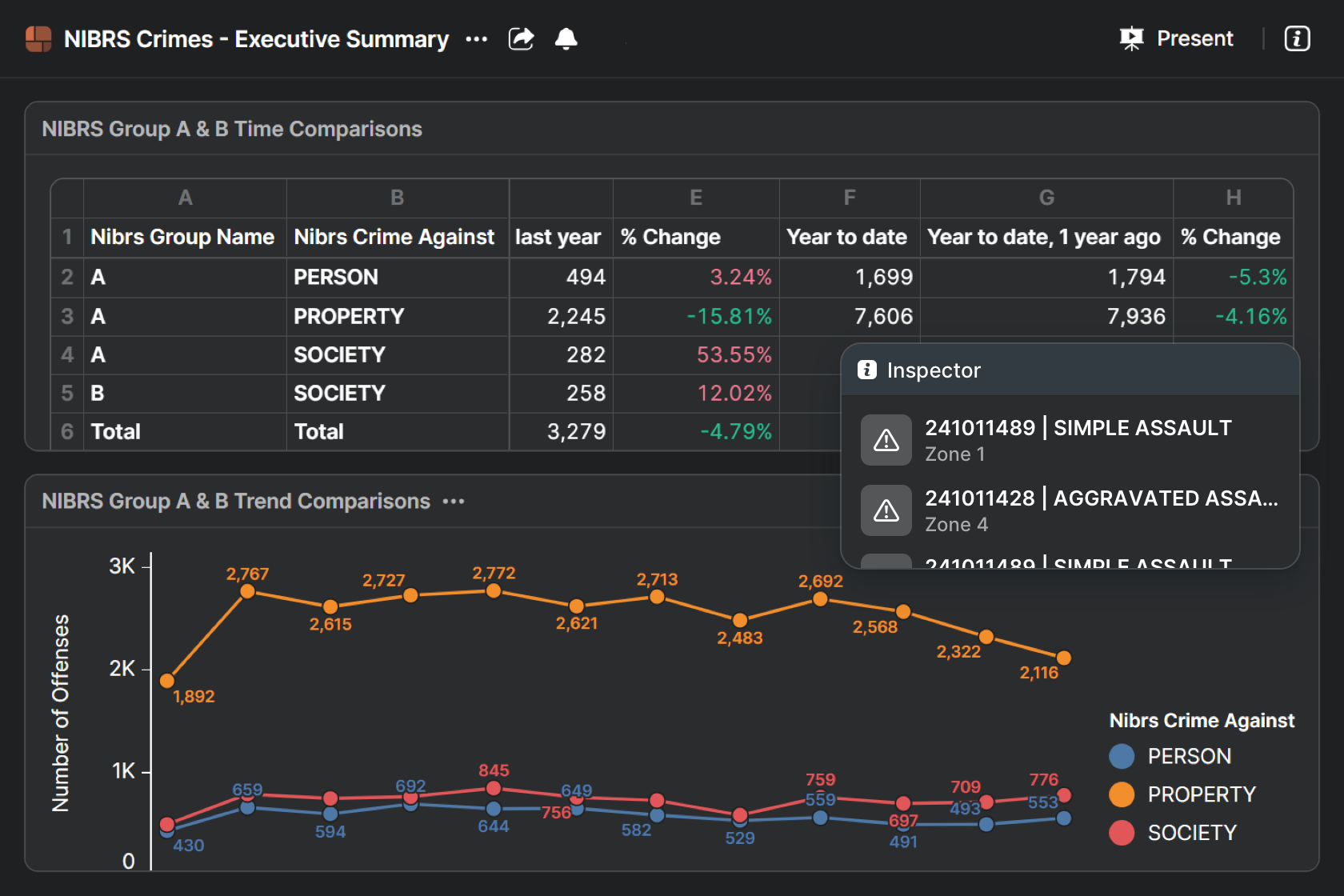
- Peregrine’s configurable, self-service dashboards update in real time to provide the most relevant, up-to-date information for CompStat presentations.
- Data visualizations in Peregrine are clickable; if a CompStat stakeholder has a question about a trend illustrated in a graph, they can click on that portion of the graph to investigate the underlying data and better understand the “why.”
The above image contains notional data.
Moving CompStat from static reporting to dynamic analysis
“Whether you’re a midsize agency like us, a large agency, or one of the largest agencies in the world, like LA or New York, everybody needs to know the ‘why.’” —Chief Ed Hudak, Coral Gables Police Department
- Dynamic CompStat presentations enable analysts to answer questions from leadership quickly, accurately, and using the most up-to-date information available.
- By allowing leaders to ask more granular questions of and get better answers from their CompStat data, Peregrine creates a more interactive, informative, and effective CompStat process for all stakeholders.
🔎 CASE STUDY: ANSWERING THE ‘WHY’ BEHIND OVERDOSE TRENDS IN CORAL GABLES
- Chief Hudak said Peregrine helped his department better understand fentanyl usage and overdoses in Coral Gables.
- Once the agency started tracking the fire department’s uses of Narcan to treat overdoses, it became apparent that overdoses were trending upward among housed residents.
- Peregrine then gave Hudak and other leaders the data they needed at their fingertips to further investigate the underlying causes.
- “We started working on, where’s the dope coming from? How can we start working those things?” Hudak said. “It really answers the ‘why.’”
Operational benefits of real-time CompStat for Coral Gables PD
“With Peregrine, every day is a CompStat day.” —Chief Ed Hudak, Coral Gables Police Department
Moving CompStat into Peregrine yielded several operational benefits for the Coral Gables Police Department:
- Reduced workload for analysts
- Improved situational awareness for command staff
- Greater confidence in the data used for operational decisions
- Stronger community engagement
Let’s dive into those benefits.
Reduced workload for analysts
Before Peregrine, CGPD analysts relied on tedious manual workflows for CompStat, such as:
- Going through disparate data sources one by one to extract information
- Analyzing data and creating visualizations
- Building static slide decks
However, CompStat is only part of analysts’ job, and any time spent on CompStat tasks is time they can’t invest in other aspects of their role. By automating the most tedious CompStat tasks, Peregrine frees up analysts to focus on more meaningful work, such as:
- Operating the real-time crime center
- Compiling crime statistic and hotspot reports
- Supporting investigations
“We're like an octopus,” Pozo said. “But now, with Peregrine, we are able to have an extra tentacle that really assists in reducing the overall workload, which is really great. It's an all-in-one tool that I utilize a lot.”
Improved situational awareness for command staff
With Peregrine, Chief Hudak and other CGPD command staff can now:
- Ask more detailed questions of their data
- Get more reliable answers
- Seamlessly contextualize their internal data with shared information from partner agencies
Hudak said this improved situational awareness makes CompStat meetings more efficient and valuable.
“Peregrine does such a great job, there are no excuses,” Hudak said. “You have to know what’s going on.”
Greater confidence in data used for operational decisions
Peregrine doesn’t just integrate data — it cleans, harmonizes, and models it on an ongoing basis to support fast, confident decision-making. Here’s how Peregrine enhances agencies’ data to make it more reliable:
- Deduplicates redundant person records across source systems, including legacy RMS and CAD systems
- Provides a clear, clickable source lineage for all data, enabling easy verification and investigation
- Makes unstructured data — such as scanned documents and audio footage from body-worn cameras — searchable
Stronger community engagement
“If we’re identifying subjects and clearing cases in a much more timely fashion, that helps us get to a point where the community feels that they’re being listened to, that we're on top of it, and they feel safe.” —Chief Ed Hudak, Coral Gables Police Department
Every hour saved on CompStat is an hour CGPD can reinvest in its community. By transitioning to a more efficient, effective CompStat process, the agency has reduced its draw on resources while improving its ability to prevent and combat crime, freeing up patrol officers to spend more time embedded in their communities.
“If I lessen the time we spend doing reports and analytics, it gives us more time as a department to get out there in the community and make people feel safe,” Hudak said. “I believe what Peregrine does for us is it gives us the ability to mingle with the community, so we’re not just responding to issues that require us to be out there.”
Key takeaways: How Peregrine transformed CompStat for the Coral Gables PD
- Coral Gables PD modernized its CompStat program using real-time data integration and interactive dashboards in Peregrine.
- Peregrine unified CAD, RMS, and other agency data into a single operational platform.
- By sharing data with regional partners in Peregrine, CGPD further improves situational awareness and cross-jurisdiction crime analysis.
- Peregrine replaced manual analysis workflows and static slide presentations with automated visualizations and interactive dashboards that update in real time.
- By making CompStat more dynamic and up-to-date, Peregrine helps command staff answer deeper operational questions about crime trends.
- Peregrine reduces the CompStat workload for analysts, provides better situational awareness for command staff, and frees up CGPD personnel to invest more time in their communities.
Schedule a demo to learn how Peregrine can help your agency modernize its CompStat process.


 Your Privacy Choices