How the Caldwell Police Department automates shift briefing reports to streamline patrol handoffs
Author
Brenna Swanston
Customer Marketing Manager
Peregrine
Published
March 26, 2026
Author
Brenna Swanston
Customer Marketing Manager
Peregrine
Published
March 26, 2026
Share


KEY IDEAS:
- The Caldwell Police Department (CPD) previously used a manual process for patrol shift handoffs that involved pulling information from several disparate systems to compile an end-of-shift briefing report.
- The manual workflow was time-consuming and carried an increased risk of bias and information gaps in CPD’s shift briefing reports.
- Peregrine automated the reporting process by instantly collating relevant data from CPD’s various information systems and integrating that data on a unified, interactive dashboard.
- Now, CPD can generate comprehensive patrol shift briefing reports instantly, streamlining the shift handoff process and closing information gaps.
- CPD patrol officers now start their shifts with stronger situational awareness to inform priorities and operational decisions.
CALDWELL POLICE DEPARTMENT AT A GLANCE:
- Location: Caldwell, Idaho
- Established: 1903
- Population: Approx. 73,088
- Sworn count: 73 officers
- Total personnel: More than 90
Sources: CPD, U.S. Census
CALDWELL, Idaho – Patrol shift handoffs in law enforcement are structured to transfer operational awareness from one patrol shift to the next. Outgoing officers record important details from their shift so incoming officers can quickly get up to speed on investigations, safety risks, and incidents requiring follow-up action.
At the Caldwell Police Department, each shift handoff involves an end-of-shift report detailing:
Before Peregrine, CPD patrol sergeants and officers had to manually compile and write out their end-of-shift reports. Officers toggled between multiple information systems to pull notes and collate incident details, and their supervisors would then type out a report at the end of each shift.
Now, Peregrine automates that process, creating comprehensive patrol shift passdown reports that eliminate context switching and manual workflows. CPD’s patrol officers can start their shifts with a more reliable and complete understanding of recent incidents and ongoing investigations, improving situational awareness and operational decision-making.
“We have to send out an email to other staff at the end of each shift with any important events that happened during our shift or follow-ups that need to happen during the next shift. Peregrine automatically summarizes all of that information, including how many calls patrol officers responded to, how many 911 calls came in, and critical incidents that occurred during the shift.” —Sgt. Andrew Holmes, Caldwell Police Department
Shift change processes are critical for operational continuity in policing. However, manual shift changes can be clunky, tedious, and inconsistent. Here’s how patrol shift handoffs looked at CPD before Peregrine automated the process:
“Before, when we created shift rollups, we had to recall what happened during the shift and manually choose what to include in the rollup,” said CPD Sergeant Andrew Holmes. “So it was a more subjective process, and the rollups weren’t as comprehensive. If we were to do what Peregrine is doing now, it would have taken us a very long time.”
💡 WHAT ARE THE RISKS OF MANUAL SHIFT CHANGES IN LAW ENFORCEMENT?
- Duplicated efforts among personnel
- A lack of operational continuity for investigations and cases requiring follow-up
- Potential for missed BOLOs or suspects
- Possible errors, information gaps, or bias due to reliance on memory
- Impacts to officer safety due to incomplete situational awareness
“If we were to do what Peregrine is doing now, it would have taken us a very long time.” —Sgt. Andrew Holmes, Caldwell Police Department
Peregrine improves patrol shift handoffs by integrating data from disparate systems — such as CAD, RMS, digital evidence systems, and automated license plate recognition (ALPR) systems — on one seamless, centralized platform that enables instant analytics and reporting.
Here’s how Peregrine generates patrol passdown reports:
“It’s useful because I can set the date range to see what our team did that day, or in the last two weeks, and it’ll just give me a rundown of everything,” Holmes said. “It automatically compiles all of our tasks from that time period, including things I might have missed if I’d put together the report manually from memory.”
💡 AI WITH INTEGRITY: All AI-generated summaries in Peregrine come with clear, clickable source citations, making it quick and easy for users to verify information and explore the source data underlying each claim.
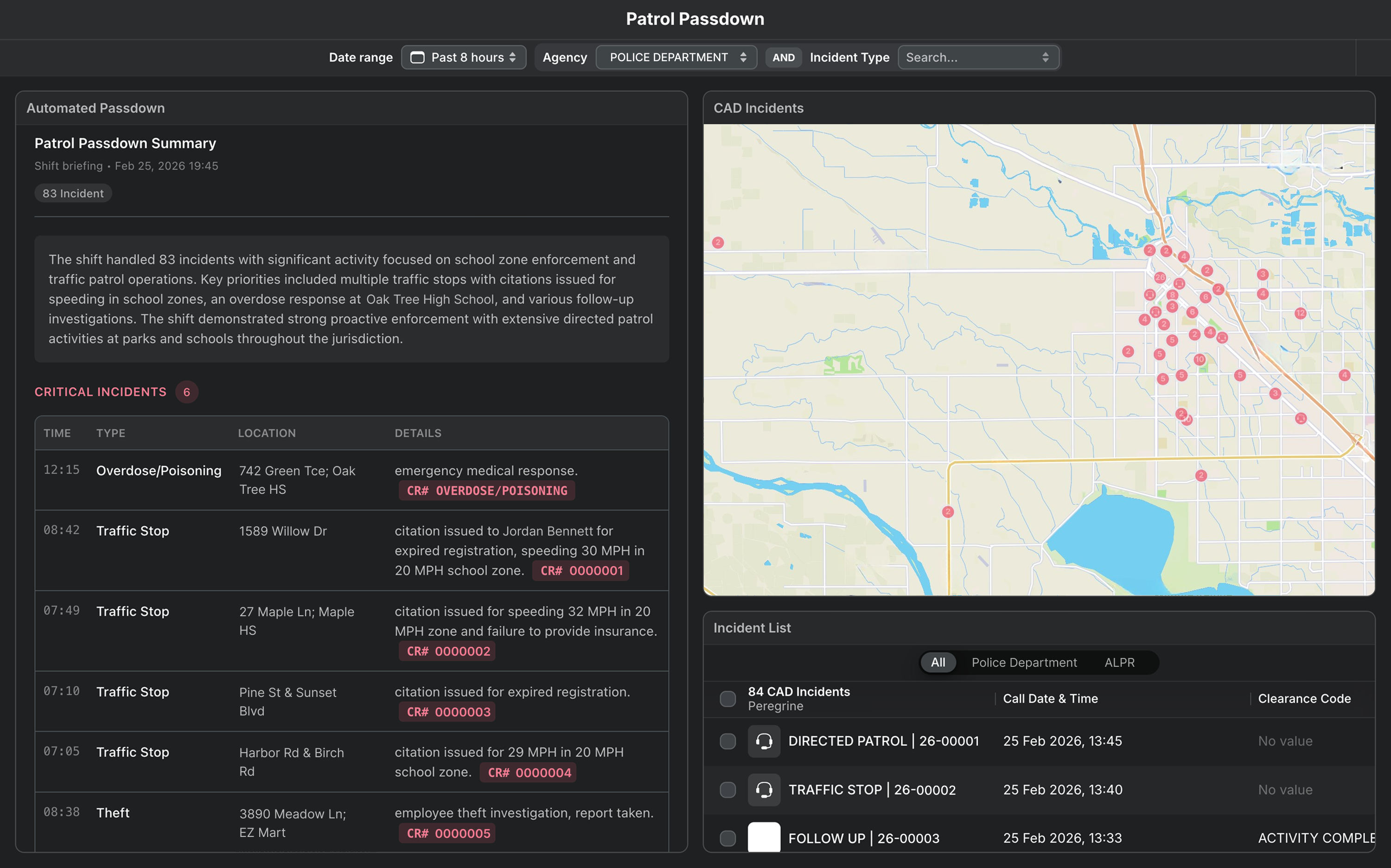
The above image contains notional data.
In addition to being objective and comprehensive, Peregrine’s patrol passdown reports are interactive. Users can click into any CAD incident, for example, to view details on the call, including related cases, persons, and arrests.
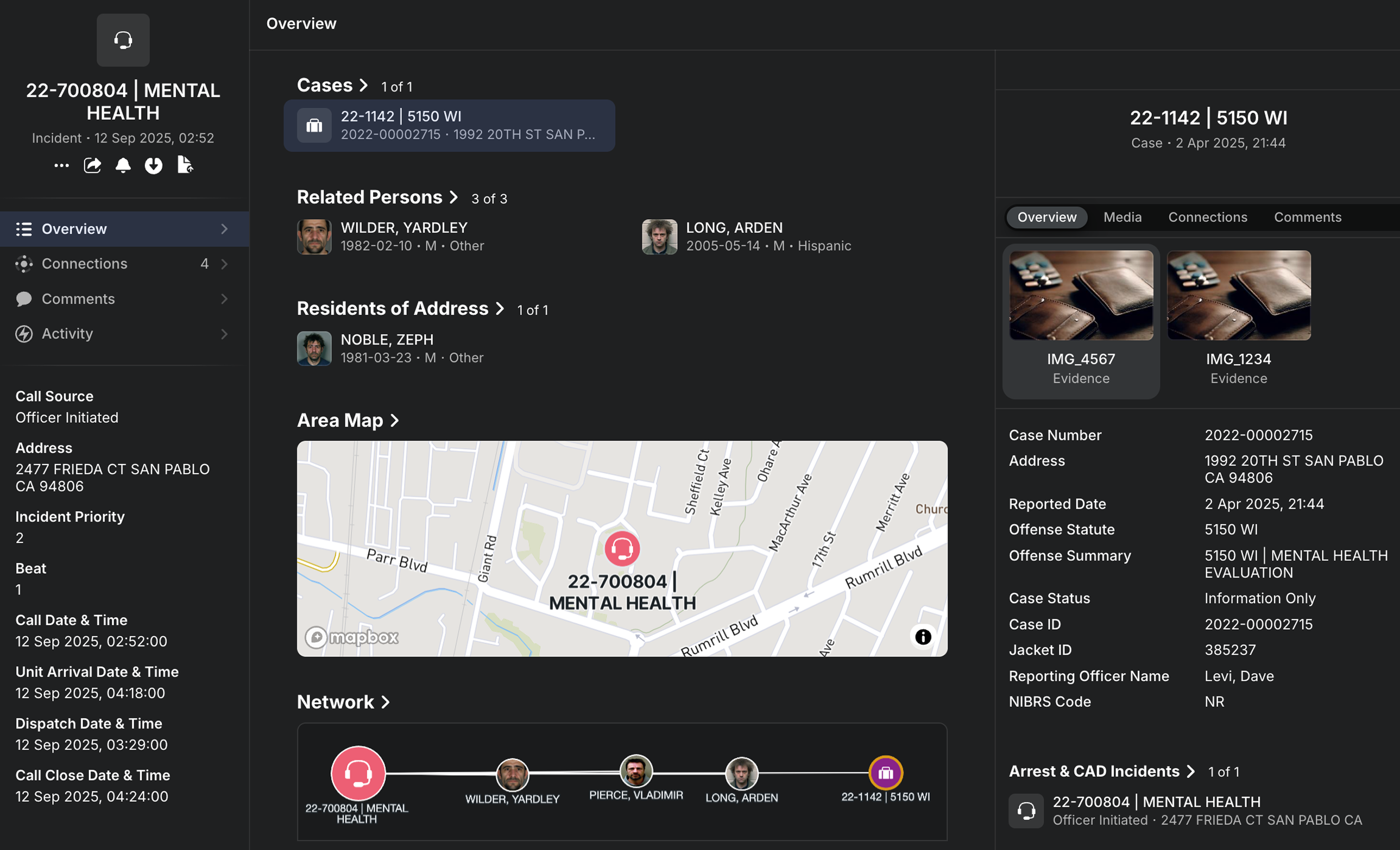
The above image contains notional data.
| Before Peregrine | After Peregrine | |
|---|---|---|
| End-of-shift reporting workflow | 1. Recall critical incidents and activity from shift 2. Log into multiple information systems to retrieve incident and activity notes 3. Manually type out end-of-shift report 4. Send end-of-shift report to command staff and incoming patrol shift | 1. Set desired date or time range 2. Instantly generate patrol passdown dashboard illustrating critical incidents and CAD activity 3. Click into specific incidents as needed to view granular details 4. Share patrol passdown report directly in Peregrine or via your agency’s preferred channel |
| What officers see in an end-of-shift report | Written report detailing calls for service, arrests, BOLOs, actions requiring follow-ups, and other critical incidents based on what officers could remember and the notes they could manually retrieve from their disparate information systems. |
|
| Potential operational impact |
|
|
Shift changes are a painful manual process for many law enforcement agencies — but they don’t have to be. By automating end-of-shift reports in Peregrine, CPD’s patrol staff now start each shift with an accurate, complete understanding of what’s happening in their community.
“My team starts every shift with a clear picture of what they need to know and go do,” said Sgt. Holmes. “Peregrine automatically summarizes activity from the prior shift, plus it highlights critical incidents and follow-ups needed based on what happened.”
To discover how Peregrine can enhance your agency’s operations, learn how we support law enforcement.
A patrol shift handoff is the process of transferring situational awareness from one patrol shift to the next. Officers typically compile an end-of-shift briefing including key information about calls for service, incidents, suspects, and investigations. This helps the incoming shift understand what happened and what requires follow-up.
For media requests,
contact media@peregrine.io
 Your Privacy Choices