
"From a command standpoint, analyzing historical data is critical whenever you’re making budgetary requests or you need more resources. How can a chief go to their elected officials and say they need more police officers if they can’t show that crimes or calls for service are trending upward? You can’t just say, ‘because I said so.’ Peregrine now allows us to look at historical data and trends over a longer period, without having to do tedious manual work.”
Jack Dale
Assistant Chief, Boynton Beach Police Department

KEY IDEAS:
- The Boynton Beach Police Department (BBPD) has gone through three different vendors for its computer aided dispatch (CAD) and records management system (RMS) data in the last six years, resulting in fragmented data stored across multiple platforms.
- Vendor lock-in practices and inconsistent formatting made it difficult or even impossible to access, search, and analyze historical data from BBPD’s legacy CAD/RMS systems.
- Peregrine integrated BBPD’s three CAD/RMS systems within 90 days, unblocking access to critical historical data, deduplicating redundant records, and standardizing formats to enable cross-system analysis.
- Now, BBPD command staff and detectives can view and analyze historical CAD/RMS data on a single platform, with just one login and one search. As a result, they can show longer-term trends and conduct faster investigations.
Analyzing a crime trend or compiling an offender’s criminal history shouldn’t require a multi-system scavenger hunt. But for years at the Boynton Beach Police Department, it did.
With CAD and RMS data scattered across three disparate platforms, accessing BBPD’s historical data was once a challenge — and in some cases, impossible. Plus, each platform coded its data in different formats, making cross-system analyses a huge lift. As a result, command staff struggled to understand long-term trends, and detectives were stuck with inefficient investigative workflows.
But that changed when BBPD deployed Peregrine. Within 90 days, Peregrine:
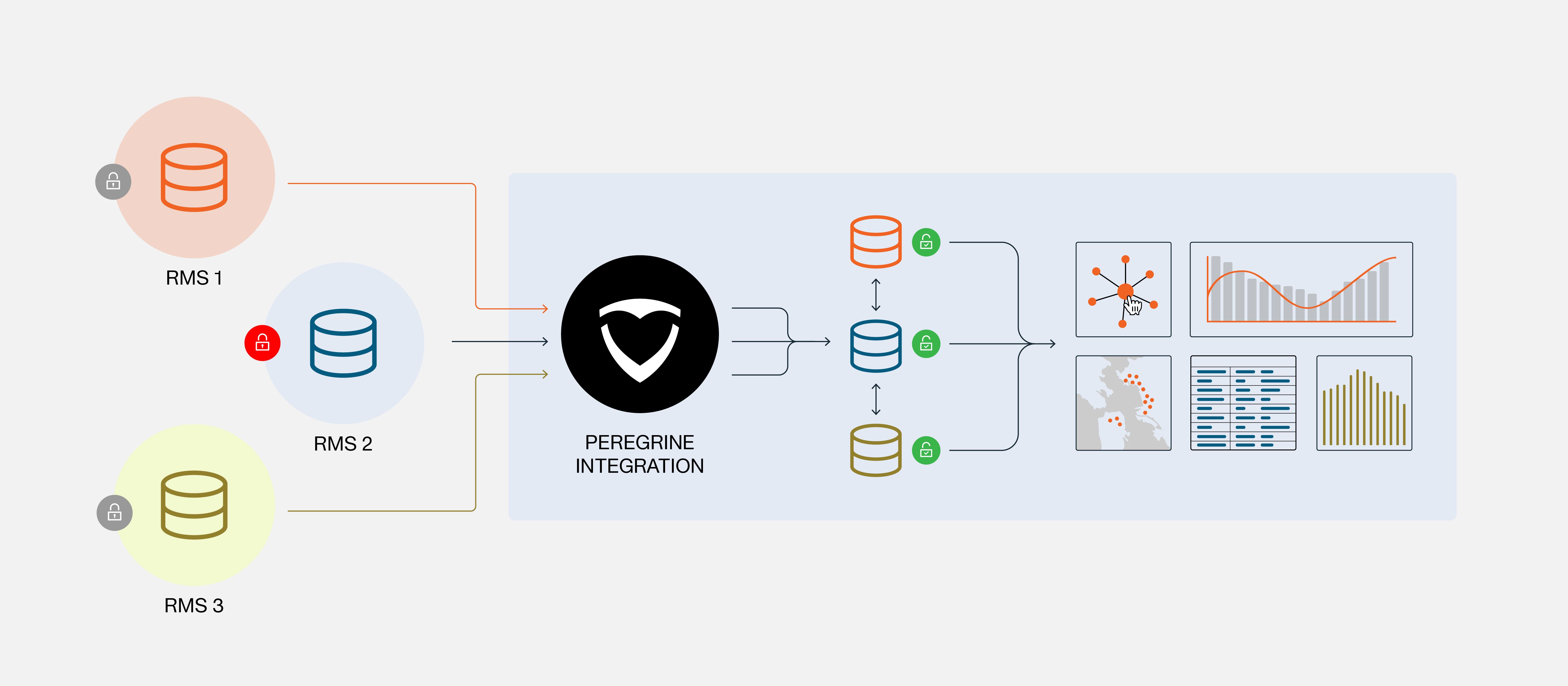
- Integrated data from BBPD’s last three CAD/RMS solutions on one unified platform
- Improved access to data that already belonged to BBPD but had been locked down by previous vendors
- Standardized data formats and deduplicated records to enable analysis across multiple source systems
- Enhanced the agency’s search capabilities for faster, more reliable outcomes
- Turned years’ worth of fragmented data into a single source of truth for command staff, detectives, analysts, and officers
Keep reading to learn how Peregrine has transformed BBPD’s data capabilities.
Integrating historical data from disparate RMS platforms
Before BBPD deployed Peregrine, the agency’s data was scattered across its current CAD/RMS solution and two legacy platforms. Vendor lock-in and formatting inconsistencies made it difficult to access, search, and analyze historical data across multiple systems.
“In a six-year span, we had three different RMS and CAD providers, and each system does things its own way, so bringing together data from the different systems was a massive project,” said BBPD Assistant Chief Jack Dale. “Previously, you had to export the data to separate spreadsheets and try to blend them together. It wasn’t easy. Peregrine makes it easy.”
Why was historical data difficult to access?
Each system posed challenges when it came to accessing and analyzing data:
- First CAD/RMS (used until 2021): Contained decades of historical data with limited filtering capabilities and a limited number of login accounts across all of BBPD, creating bottlenecks for data access, management, authentication, and analysis
- Second CAD/RMS (used from 2021–2023): Contained two years of records and incident data, which became largely inaccessible to BBPD after the contract ended and the vendor decommissioned the servers hosting the agency’s data
- Current CAD/RMS (used from 2023–present): Could not properly integrate data from the first two systems, limiting the agency’s ability to analyze long-term trends using data from before 2023
“Most companies don’t want to integrate data from someone else’s product into theirs,” said BBPD Assistant Chief Jack Dale. “So when we tried to migrate data from one CAD/RMS into another, it was never a full integration. We found there were records we needed that we didn’t have access to, in ways we hadn’t anticipated.”
READ MORE → Open and Interoperable: Advocating for Better Data Stewardship
How did Peregrine unlock access to legacy CAD/RMS data?
Unlike vendors that resist integrating data from other providers’ products, Peregrine works with virtually all data sources and types, including both unstructured and structured data.
By integrating data from BBPD’s CAD/RMS systems, Peregrine enabled authorized users at the agency to view, model, analyze, and export data across all three sources — with just one login. Now, command staff can measure long-term trends to demonstrate the success of department initiatives and substantiate needs for additional resources.
"From a command standpoint, analyzing historical data is critical whenever you’re making budgetary requests or you need more resources,” Dale said. “How can a chief go to their elected officials and say they need more police officers if they can’t show that crimes or calls for service are trending upward? You can’t just say, ‘because I said so.’ Peregrine now allows us to look at historical data and trends over a longer period, without having to do tedious manual work.”
🔒 DATA SECURITY AT PEREGRINE
- Peregrine automatically enforces data protection and governance parameters according to the policies and regulations applicable to each customer organization.
- Peregrine abides by least-privilege access principles, meaning administrators from each customer org may grant permissions based on users’ roles, contextual attributes (such as IP address), or intended purpose for accessing sensitive data.
- Peregrine maintains a SOC 2 Type II attestation; has successfully completed an ISO 27001 audit; and complies with HIPAA, HITRUST, and CJIS standards for protected health and criminal justice data.
Learn more about Peregrine’s data security and governance principles: Trust at Peregrine
Cleaning and organizing data to enable cross-system analysis
“Before, if we wanted to find information about someone, the best-case scenario was that we would search their name in each individual RMS and find different records in each system. With Peregrine, we just have to run one search in one place.” —Assistant Chief Jack Dale, Boynton Beach Police Department
Before Peregrine, each of BBPD’s CAD/RMS systems coded data in different formats, blocking efforts to analyze data across multiple sources. For example, an offender with a small physical build might appear in all three of BBPD’s CAD/RMS platforms, but with the “build” field populated differently in each:
- **First CAD/RMS: “**S”
- Second CAD/RMS: “Sm”
- Current CAD/RMS: “Small”
Because such inconsistencies were so common, any attempt to search or analyze data across multiple sources would have resulted in a system error. Understanding an offender’s full history and profile required a separate search in each CAD/RMS platform, and deduplicating records was a manual process that took place in external spreadsheets.
Standardizing data formatting
When Peregrine integrated BBPD’s CAD and RMS data, it standardized formatting across all source systems — for example, by converting all entries indicating a small physical build to “Small” instead of “S” or “Sm.” Now, users can run cross-system analyses without bumping into errors due to formatting inconsistencies.
“Having it all in one place is huge because we can analyze it all in the same place as well,” Dale said. “Before, if we wanted to find information about someone, the best-case scenario was that we would search their name in each individual RMS and find different records in each system. With Peregrine, we just have to run one search in one place.”
Deduplicating person records
Previously, if an offender appeared in more than one RMS, there was no efficient way to merge the different profiles into one cohesive source of truth. And if there were variations in the offender’s name spelling or address format within a single RMS, they may have had multiple profiles in that one platform, making the process even more complex.
Peregrine uses a proprietary algorithm called Match to detect when multiple records refer to the same person and merge those records into a consolidated entity. Now, searching an offender’s name in Peregrine pulls up one clean, comprehensive, organized profile containing records from all of BBPD’s integrated systems.
🔒 HOW PEREGRINE MATCH PROTECTS SENSITIVE DATA
- Match does not change the original records in the underlying data sources. It creates a new record for the merged data and uses a designated symbol to indicate when a record has been merged. This guarantees data preservation, traceability, and transparency.
- Role- and attribute-based data access controls are enforced throughout the matching process. End users only see data they are explicitly authorized to access.
- All merged records provide clear lineage to their source data. With a few clicks, administrators can review, audit, and edit merged entities at any time.
- Record managers can correct erroneous merges and manually merge missed records. Keeping a human in the loop allows for quality control over the automated matching process.
- Match is opt-in only. When customers opt in, the original records remain accessible in Peregrine, ensuring an audit trail and continuous access to the source data.
One search, every system
“Having the ability to geofence an area and search within specific geographic locations across all your CAD and RMS data is exciting. It means you can eliminate a lot of tedious work and find your answers relatively quickly.” —Assistant Chief Jake Dale, Boynton Beach Police Department
Before Peregrine, BBPD’s second CAD/RMS platform was locked down and impossible to search, with only a fraction of that data integrated into the agency’s current platform. The other CAD/RMS platforms were accessible, but their search functions required precise inputs and still often returned only partial results.
Now, BBPD’s officers and analysts can use Peregrine to conduct a single cross-system search producing fast, reliable outputs — even if the search query provided only partial information or contained a typo. Peregrine also allows users to limit their search results to specific dates or geographic areas.
“Before, if a detective was trying to identify a suspect and understand their associates, they had to look through all the past systems to try and make those connections,” Dale said. “Now, Peregrine puts all that data in one place, making the link analysis and search functions more powerful. You can specify exactly what you’re looking for. Having the ability to geofence an area and search within specific geographic locations across all your CAD and RMS data is exciting. It means you can eliminate a lot of tedious work and find your answers relatively quickly.”
💡 EASE OF USE FOR ANY ROLE
Peregrine is easy to learn for users of all ranks and roles, enabling the to start seeing operational benefits fast.
- For command: Interactive dashboards provide a bird’s-eye view of teams, projects, and resources across the agency.
- For analysts and real-time operators: Live CAD feeds pair with relevant historical data to deliver both real-time insights and comprehensive context.
- For patrol officers and other first responders: The mobile app places critical, timely situational awareness right in their hands.
“Peregrine is intuitive,” Dale said. “Prior to being trained, I found information I was unable to see before. The more I use it, the more I understand the navigation of it. I don’t have to do anything special for that.”
Tailored deployment experience
"The deployment strategists are here. They’re on scene. They understand that the best way to get to the finish line is to come here, meet with people in person, and get there together.” —Assistant Chief Jack Dale, Boynton Beach Police Department
Assistant Chief Dale said Peregrine’s delivery model has been key to the platform’s success at BBPD. The same Peregrine deployment strategists who partnered with BBPD’s leaders to identify the agency’s biggest challenges also configured the platform to address those challenges. That continuity — paired with regular on-site visits from the deployment strategists — has maximized Peregrine’s value for BBPD.
"The deployment strategists are here,” Dale said. “They’re on scene. They understand that the best way to get to the finish line is to come here, meet with people in person, and get there together. That’s not the norm. We also work with the same deployment strategists each time, so they have not only a very thorough knowledge of the product but also a deeper understanding of our department’s needs.”
Integrate data from your department’s legacy systems
When BBPD found Peregrine, its most critical data was fragmented across three disconnected systems with varying levels of visibility and access. Now, all of the agency’s CAD and RMS data is available on Peregrine’s unified, self-service platform, standardized and organized to streamline analysis and enhance understanding.
To learn how your department could benefit from Peregrine’s data integration technology, schedule a demo.


 Your Privacy Choices